Why is my AC running but not cooling the house?
Common causes include a dirty filter, an iced-over coil, low refrigerant from a leak, or a failed outdoor part. Check the filter and thermostat first. If air stays warm, request a provider visit.
Request an estimate from a local provider
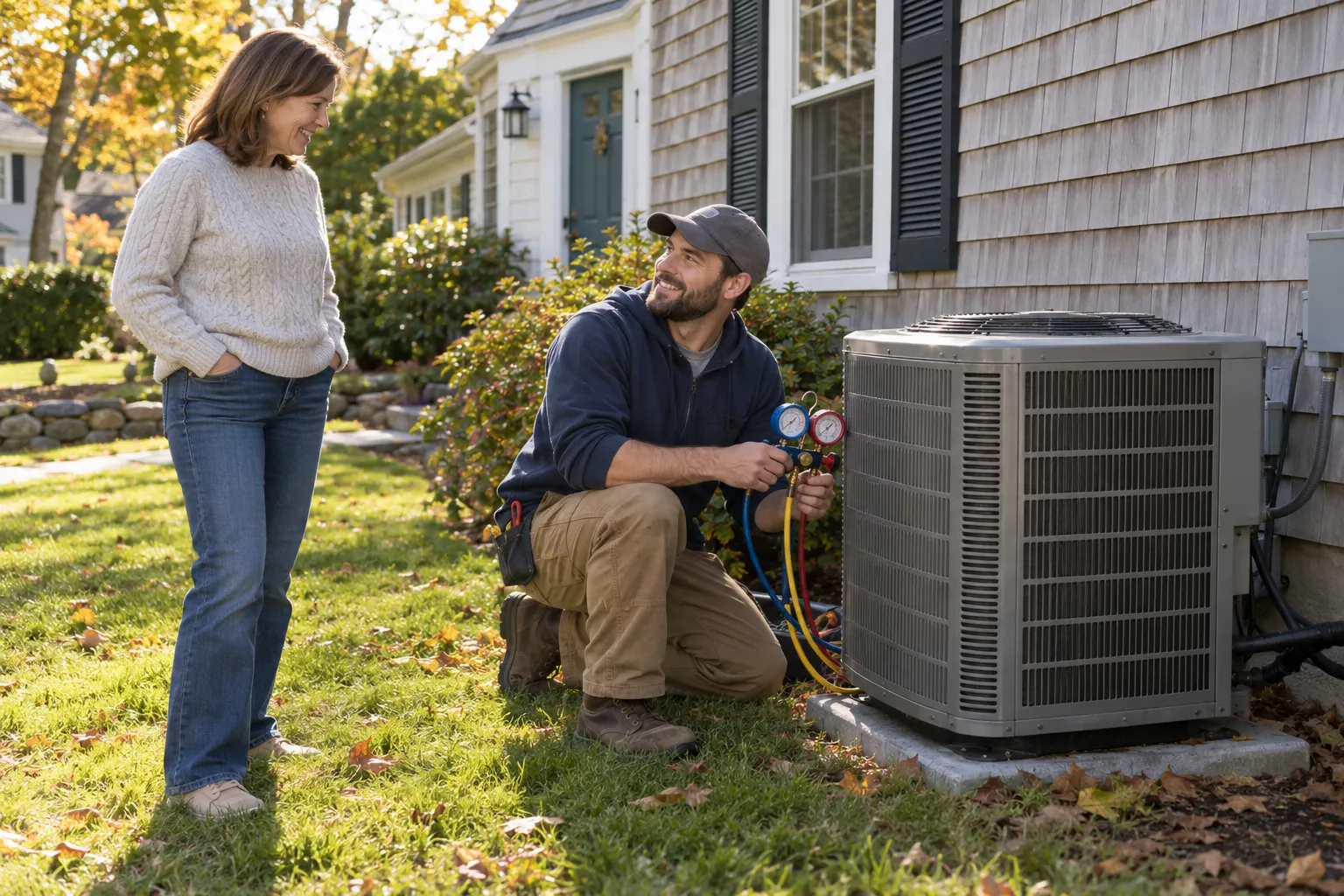
Many people assume an AC problem can wait until it gets worse. It usually pays to act early. A weak breeze, a short cycle or a strange hum often points to something a provider can fix in one visit.
Eighthunt Heating & Air is a referral service. We do not repair air conditioners. We connect homeowners in Stamford, CT and the Stamford area with independent local HVAC providers who do the work. You describe what is happening, and a provider in our network follows up. There is no obligation to hire anyone. This page covers the signs to watch, what a repair visit looks like, common fixes, typical costs and the questions worth asking before you say yes.
A lot of people think moving air means working cooling. In practice, a fan can run all day while the cooling part has quit. If the air feels warm or barely cool, something is wrong.
Some problems cannot sit. Ice on the pipes, water pooling near the indoor unit, a burning smell or a buzzing outdoor unit that will not start all call for action. Turn the system off at the thermostat. Then ask for help.
If you have a baby, an older relative or a health condition in the house, the stakes go up. Emergency AC repair is worth asking about. Request a callback to check provider availability in your area.
A few quick checks can save a trip, or give the provider useful clues:
If none of that helps, stop fiddling. Repeated resets can strain parts.
Hot weather does make a system work harder. But a healthy AC still pulls the indoor air down. If rooms stay warm while the unit runs for hours, the system is losing ground. That is a repair sign, not a weather sign.
Look before it breaks. These small signs often show up first:
Any one of these is a good reason to request a check.
Myth: a noisy AC is just an old AC. Reality: noise is a message. Grinding can mean a worn motor or bearing. Squealing may point to a belt or fan issue. Clicking that repeats without the unit starting can signal an electrical part. Rattling sometimes means a loose panel, which is an easy fix.
A musty smell can mean moisture or a clogged drain. A sharp, electrical smell means turn it off. Water around the indoor unit often comes from a blocked condensate line. In homes with full basements, that water can quietly soak stored items.
It feels thrifty to wait. But a system that is struggling gets pushed hardest in a heat wave, which is also when providers get busy. Acting at the first sign gives you more choices.
Timing changes the outcome. Here is a typical pattern when a cooling problem is ignored:
Not every system follows this path. Many do.
Refrigerant does not get used up like fuel. If levels are low, there is a leak somewhere. Adding more without finding it is a short-term patch. Ask the provider to locate and repair the leak.
The provider checks the thermostat, filter, airflow, electrical parts, coils, drain line and refrigerant levels. They test the system and explain what they found. A good provider shows you the problem in plain words and gives a written quote before starting larger work. You decide whether to go ahead.
Many cooling problems come down to a handful of parts:
Older houses often have tight attics, long duct runs and cramped utility spaces. That can limit airflow and hide problems. Coastal storms and salty, damp air can wear outdoor units over time. After a long cold season with snow and ice, check that the outdoor unit is clear and the cabinet is not damaged before you turn cooling on for the year.
Repair usually makes sense when the system is not very old, the problem is a single part and the quote is modest. Replacement starts to make sense when repairs keep stacking up, the unit is well past its expected life or a major part has failed. A provider can walk you through both paths. Replacement has its own page on this site.
The pattern is simple. Small signs show up first. Acting early usually means a smaller fix. If your AC is acting off, Request a callback to talk with a provider in our network, or use the request form.
A provider checks airflow, electrical parts, coils and refrigerant to find why your home is not cooling.
Capacitors, motors, contactors and drain lines are fixed or replaced as needed.
Providers explain findings in plain words and give a written quote before larger work starts.
Ask about urgent visits for ice, leaks or a dead outdoor unit; availability varies by provider.
Prices vary by home, system age, part and local rates. These are typical U.S. ranges, not quotes. Always ask the provider for a written quote that lists parts and labor before you approve work.
| Repair item | Typical range | Notes |
|---|---|---|
| Diagnostic visit | $75 – $200 | Often applied toward the repair; ask first |
| Capacitor or contactor | $120 – $450 | Common starting problem; quick part swap |
| Drain line clearing | $100 – $350 | Helps stop leaks and water backup |
| Refrigerant leak repair and recharge | $200 – $1,500 | Depends on leak location and refrigerant type |
| Fan or blower motor | $400 – $1,500 | Indoor and outdoor motors differ in price |
| Compressor replacement | $1,800 – $4,000 | Often a repair-or-replace decision point |
Tell us what you notice: warm air, noises, leaks or a unit that will not start.
A provider in our network near Stamford follows up to discuss your situation and availability.
Ask for a written quote that lists the parts and labor.
Approve the repair, ask more questions or decline. The decision is yours.
Small cooling problems are usually simpler to fix than the damage that follows when a struggling system keeps running.
Providers in our network are local businesses, so you compare real quotes and choose for yourself.
Ask questions and expect straight explanations, not jargon, before you agree to any repair.
Requesting an estimate does not commit you to hire anyone. You stay in control.
Tell us what your system is doing. Request an estimate or ask about provider availability, with no obligation to hire anyone.
No obligationCommon causes include a dirty filter, an iced-over coil, low refrigerant from a leak, or a failed outdoor part. Check the filter and thermostat first. If air stays warm, request a provider visit.
It is usually better to turn it off. Running a struggling system can iced-over coils or strain the compressor, which turns a smaller repair into a bigger one.
Many repairs fall between about $150 and $1,500, depending on the part and the job. Major parts like compressors cost more. Always get a written quote before work starts.
Tell us what your system is doing. Request an estimate or ask about provider availability, with no obligation to hire anyone.
No obligation